

By Howard Deevers
Weather is such an important subject in aviation that you will be quizzed on it during any check ride for any rating. It is also one of the most difficult subjects to teach to new students. Remember that I am a CFII, not a trained meteorologist. Naturally, I had to learn a lot about weather getting my Instrument Rating, and then my CFII rating. There are whole books on Aviation Weather, and with the internet, we have many sources for weather information, but where do I get my weather? From Flight Service – 1800 WXBRIEF. Yes, after I do study the weather I see on TV, the internet, or ForeFlight, I still call the experts.

Every part of the country has its own unique weather patterns and Arizona is no exception. I received all of my aviation ratings in Pittsburgh, PA. In Pennsylvania, the highest point in the state is Mt. Davis at 3213 feet MSL in the Allegheny Mountains. Much of Arizona is well above that altitude, with Humphreys Peak (near Flagstaff) topping off at 12,633 feet MSL. The Flagstaff airport is 7015 feet MSL, and many of the lower airports are about 2400 feet MSL, and Yuma is only 213 feet MSL. That is a lot of variable elevation for airports in just one state!
Yes, for sure Arizona is blessed with mild weather; most of the time. Pennsylvania; not so much. It only took me a few months past getting the Private Pilot Certificate to realize that if I were to get the utility from aviation that I wanted, I would need an Instrument Rating, and I started working toward that goal.
After moving to Arizona, I found that aviation weather can be vastly different from one part of the state to another. You may have beautiful clear skies in southern Arizona, but with strong winds and density altitude. Fly north for a short distance, and you can have snow, freezing rain, and high terrain to contend with, but only for a day. In the upper mid-west, IFR weather may stay around for more than a day.
Arizona weather, while good most of the time, can be brutal when it is not good. Most of us fly small single engine airplanes, and as such we need to be aware of that weather. Knowing the performance of the airplanes we fly is just as important as knowing what weather we will encounter. The summer thunderstorms are so localized that you can see them and, in many cases, just fly around them. Please, never try to fly through a thunderstorm in any aircraft.
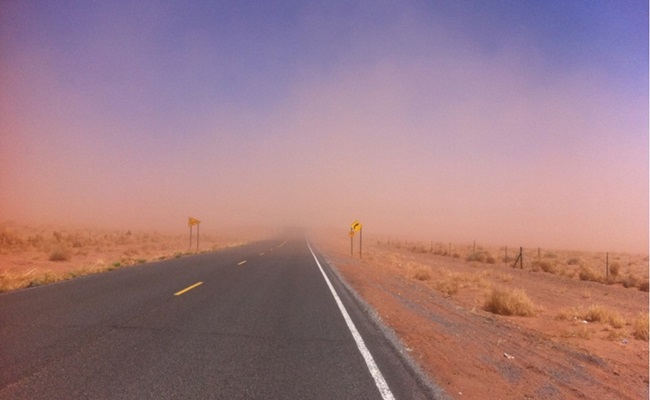
Something that I never heard about in Pennsylvania but is common in Arizona, is a Dust Storm. Yes, Pennsylvania does have its share of dust, but nothing like the Dust Storms we can have in Southern Arizona, and they are difficult to forecast. On your typical weather briefing you will get wind direction and speed at your departure airport, and your arrival airport, and winds aloft on the route, but it is difficult to predict that a dust storm can be right in your path because of a dry flat open area on your route. Another Arizona weather item that I never saw in Pennsylvania, is a “Dust Devil.” They are common in the hot summer in Southern Arizona. They rise from the surface and go up, as opposed to a tornado that comes down from a cloud. They don't look as menacing as a tornado, but if you do fly through one, you won't forget the experience. While they rise about one thousand feet from the surface, even flying over the top of them can be a turbulent event. While we are talking about winds in Arizona, remember to practice those crosswind take-offs and landings. If you are not proficient in winds and crosswinds, you are not going to fly much in Arizona.
For any cross-country flight, I start looking at weather well in advance. My instructor told me once, “Weather is what you get, not what is forecast.” By that he meant that even the best planning for weather can have surprises, and he wanted me to be prepared to divert for weather if needed. I learned that early on, and I can say that many cross-country flights were diverted because of weather ahead on my route that I would prefer not to deal with. It was the best advice that any instructor can give to any student. I also found out that weather study in aviation is a lifelong process; you never know enough about weather.
If you want to know more about weather in Arizona, come to a safety seminar sponsored by your ARIZONA PILOTS ASSOCIATION, and the FAASTeam. Check the web site for a location near you, and don't forget to “Bring your Wingman!”