
By Jim Timm
February 2015
For general information, a review of all the accidents that had been reported in Arizona for the past year were reviewed, and the following summary for 2014 was prepared to examine a breakdown of aircraft class and the injuries involved.
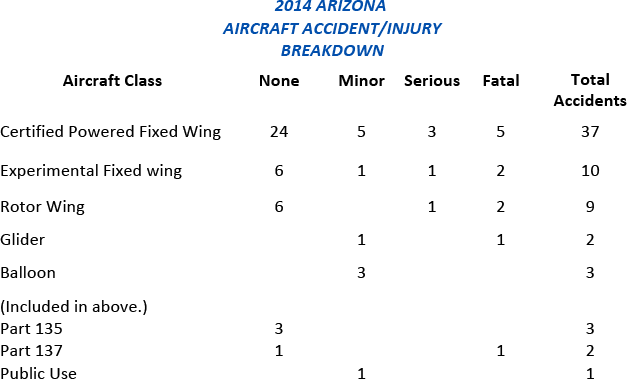
The Number Of People Involved in the Above Accidents.
74 Non Injuries This year
22 Minor Injuries This Year
8 Serious Injuries This Year
16 Fatalities This Year
120 TOTAL PEOPLE INVOLVED IN THE ABOVE 61 ACCIDENTS.
In the coming year I hope we can find a way to reduce these numbers, particularly the number of fatalities. To do this will require everyone to do their part and avail themselves of all the safety information out there and exercise good judgment and fly safely.
For the February accident report, the following are the preliminary NTSB reports of the aviation accidents that have occurred in Arizona from mid-December thru late January. Hopefully the information from these reports will be used to develop safety programs and briefings that will help pilots learn from the mistakes being made by others and thus take the action needed to prevent similar accidents from occurring.
This reporting period has not improved much from last month from a flight safety standpoint. Since the last reporting period, there were four accidents, and unfortunately, one of them was an accident with two fatalities. One accident had one uninjured person, and the other two accidents were devoid of information, and most likely the persons involved in these accidents received either minor or no injuries.
Unfortunately, there are still two reported accidents dating back to November, 2014, that are still devoid of detailed information. While devoid of details, these accidents could have been serious and should have been avoided.
During this past reporting period there were four previously reported accidents, one dating back to last September, that have finally had a detailed accident report issued. These detailed reports are appended to the end of this month’s summary.
Based on information available when this summary was prepared, the reported accidents are as follows:
Accident Date: Sunday, December 7, 2014
Report Dated (12/19/14)
Title 14 CFR Part 91
Location: Lake Havasu
Aircraft Type: Fouga CM-170R Magister
Injuries: 1 Uninjured
FORCED LANDING, CAUSE UNCERTAIN
(Last month at “press time” the official NTSB report was unavailable.)
On December 7, 2014, about 1315 MST, an experimental Fouga CM-170 Magister landed hard during an off airport forced landing near Lake Havasu. The commercial pilot was not injured. The airplane sustained substantial damage to all components of the airframe during the accident sequence. The cross-country personal flight departed Grand Canyon Airport at an undetermined time with Lake Havasu as the planned destination.
The pilot stated that he had encountered a gyro problem on the flight segment to the Grand Canyon Airport, but otherwise had no issues with the airplane. He added fuel at Grand Canyon, and should have had about 1.5 hours of fuel remaining when both engines flamed out. He made a forced landing in uneven desert terrain.
Visual meteorological conditions (VMC) prevailed, and no flight plan had been filed.
Title 14 CFR Part 91
Accident Date: Wednesday, December 31, 2014
Report Dated (1/7/15)
Location: Benson
Aircraft Type: Bell 206
Injuries: 2 Fatal
CONTROLLED FLIGHT INTO TERAIN
On December 31, 2014, at 1710 MST, a Bell 206 collided with terrain 7 miles west of Benson. The commercial pilot and pilot rated mechanic were fatally injured on a positioning flight. The
flight originated form Glendale, Arizona, at 1550, and was destined for Sierra Vista, Arizona.
The operator reported that the helicopter had not arrived at its destination and that the Sky Connect Tracking System indicated that the helicopter was at a stationary location between Tucson and Benson. The Cochise County Sheriff located the helicopter wreckage about 2030 at the location the Sky Connect system was reporting. The helicopter was fragmented into multiple pieces along a 174-foot-long debris path. Witnesses living in the local area reported hearing a low flying helicopter around the time of the accident, and that the visibility at ground level was very limited, with low clouds and fog.
The flight was operating on a company visual flight rules flight plan.
Accident Date: Thursday, January 1, 2015
Location: Yuma
Aircraft Type: Cessna 140
NO INFORMATION AVAILABLE
Accident Date: Sunday, January 4, 2015
Location: Sedona
Aircraft Type: Piper PA28R-200
NO INFORMATION AVAILABLE
THE FOLLOWING ACCIDENTS WERE PREVIOUSLY REPORTED DEVOID OF ACCIDENT INFORMATION. IN THIS DECEMBER REPORTING PERIOD, THE ACCIDENT DETAILS BECAME AVAILABLE.
Accident Date: Saturday, September 13, 2014
Report Dated (1/12/15)
Title 14 CFR Part 91
Location: Phoenix
Aircraft Type: Ultramagic N250 (Balloon)
Injuries: 2 Minor Injuries, 9 Uninjured
The pilot reported that as the balloon descended to land, about 50 feet above ground level, a wind gust and down draft resulted in a rapid descent and subsequent collision with trees. The balloon landed hard and bounced several times. During the accident sequence, the basket
flipped onto its side and was dragged in the dirt, which resulted in substantial damage to the structure. The pilot reported no pre-impact mechanical failures or malfunctions with the balloon that would have precluded normal operation.
Pilot Info: Commercial; Free Balloon
Flight Time; Total All Aircraft: 2600
Make & Model: 120
Accident Date: Thursday, October 23, 2014
Report Dated (12/19/14)
Title 14 CFR Part 135
Location: Mesa
Aircraft Type: Rockwell 690B
Injuries: 4 Uninjured
POSSIBLE MECHANICAL PROBLEM
The pilot reported that during the landing roll out, a vibration was observed coming from the nose wheel. As the airplane was decelerating to a stop, smoke was noticed coming from the nose gear area. A post-accident examination of the airplane revealed that during the landing roll out the nose wheel tire had gone flat. This resulted in the vibration of the nose landing gear, and the subsequent fire to the tire and forward section of the fuselage; the fuselage sustained substantial damage as a result of the thermal activity. The examination also revealed no anomalies with any of the nose landing gear components that would have precluded normal operation.
Pilot Data; ATP, CFI, MEL, SEL
Flight Time; Total All Aircraft: 8718
Make & Model: 62
Accident Date: Wednesday, November 5, 2014
Report Dated (1/2/15)
Title 14 CFR Part 91
Location: Havasu City
Aircraft Type: Beech A35
Injuries: 1 Uninjured
POSSIBLE MECHANICAL PROBLEM ?
The pilot stated that he was level cruise at 10,500 feet mean sea level, when he moved the fuel selector from the right tank to the left tank. The airplane was equipped with the Beech fuel selector valve disengagement warning light kit. The fuel selector is a combined fuel pump and valve assembly. The handle can be lifted up and down to pump fuel, but in this condition it is not engaged with the selector valve portion of the assembly. When the fuel selector handle and the fuel valve do not agree, the red 'fuel' light illuminates.
When the pilot selected the left tank the red 'fuel' light illuminated. He cross checked the fuel flow and fuel pressure, both of which were in the normal range. A few minutes later he entered an en-route descent, when the engine began to lose power. He pumped the fuel pump, the red 'fuel' light remained ON, and the engine did not regain power. The pilot executed a forced landing onto a road and damaged the left wing during the landing roll. A post-accident examination of the airplane was performed by a Federal Aviation Administration inspector and a technical representative from the airplane manufacturer. The fuel selector valve was found to operate as designed. The red 'fuel' light illuminated when the fuel selector handle was not engaged with the valve and aligned with the fuel tank that provides fuel to the engine. Additionally, the engine was test run and found to operate normally.
Pilot Data; Commercial, MEL, SEL, SES, Glider
Flight Time; Total all Aircraft: 7044
Make & Model: 24
Accident Date: Friday, November 7, 2014
Report Dated (1/15/15)
Title 14 CFR Part 91
Location: Bullhead City
Aircraft Type: Cessna 210B
Injuries: 4 Uninjured
MECHANICAL PROBLEM
On November 7, 2014, at 1730 MST, a Cessna 210B experienced a landing gear malfunction after takeoff from Laughlin/Bullhead International Airport. The pilot stated that after takeoff he heard a loud bang after he moved the landing gear handle to the UP position. The landing gear indication lights were not illuminated. He cycled the landing gear handle, which had no effect. He also determined that the flaps would not operate. During a low pass the tower informed the pilot that the landing gear were in a transit position (not retracted, not locked down). The pilot attempted to execute the emergency gear extension procedure, which was not successful. During the landing the gear completely collapsed, the airplane slid to a stop on its belly and tipped to the left, substantially damaging the left horizontal stabilizer. The pilot reported that an airframe and power plant mechanic visually examined the landing gear actuator, and stated that the actuator housing had split, allowing the loss of hydraulic system pressure. No further examination was accomplished and the reason for the housing failure was not determined.
Visual meteorological conditions prevailed, and no flight plan had been filed.
Pilot Data; Commercial, MEL, SEL
Flight Time; Total All Aircraft: 1401
Make & Model: 900