

By Barbara Harper and Howard Deevers
The Airman Certification Standards (ACS) are what we are required to teach for a prospective pilot to pass a check ride for Private Pilot and other ratings. The ACS and the FAR part 61 are very specific about the tasks that must be mastered to pass a check ride: Take offs, landings, maneuvers, emergency procedures, stalls and recovery, and more items must be taught to new prospective pilots. Every instructor has his/her own style of teaching. New students will believe almost anything that an instructor says or demonstrates. If the instructor said it, or did it, then it must be right.
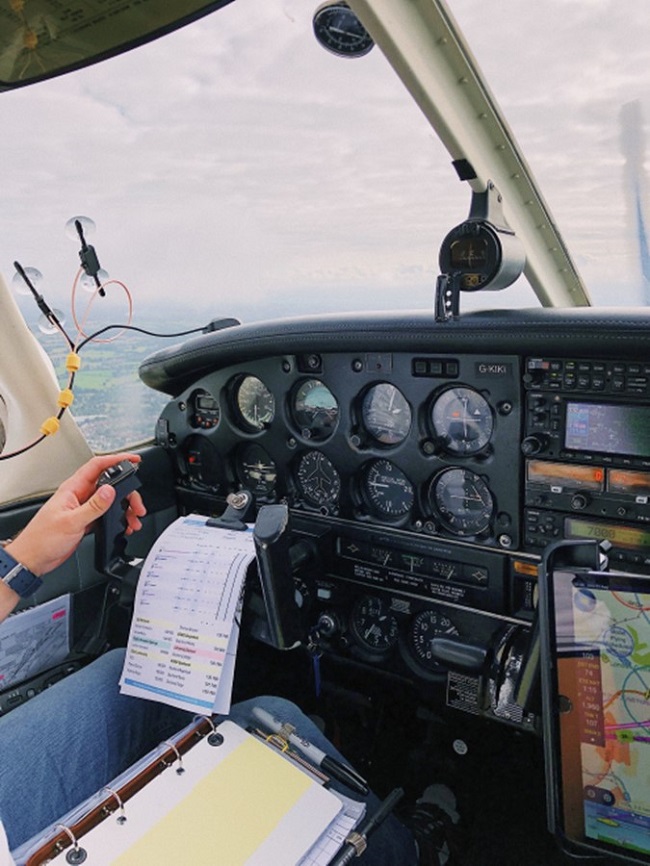
Recently, while approaching Marana Airport (KAVQ) to meet a friend, a student pilot on a solo flight was also approaching the airport. Coming from the Phoenix region, he was following the I-10 route to the “Cement plant.” His radio calls were quite good, but very lengthy: “Marana traffic, Cessna 1234, at the Cement Plant, student pilot solo. Planning a 45 entry to downwind for runway one-two, full stop, taxi back on taxiway A, Marana Traffic.” Then when on the 45 entry we got the same information again, and again on downwind, and on base, and on final.
The good thing is that his instructor did a good job of teaching him to communicate. The problem was that he was transmitting too much information on each call on a busy frequency. It is nice to know where a plane is in the pattern, but we don't need to know that he will be full stop, what exit he will turn off at, and what taxiway he will use with each call.
Observational learning is when students learn from observing. We have all done that, and it helps cement a task, but to “unlearning” something in aviation is not an easy task. Communicating on the radio is intimidating for new students (it was for me, too), and we learn from observing our instructors. On your checkride, the examiner will expect you to do all of the communicating. The examiner will give you a lot of liberty in how you communicate, as long as you respond to ATC instructions and can be clear about your intentions. Most of us improve our communications after we receive our pilot certificate.
Thanks to more tools, content, and technology we can develop new skills and build expertise on our own. A problem comes into play when a task we learned is no longer the appropriate task because the aviation world around us has changed. Now we need to identify the old knowledge and assimilate the new. The “old method” that we learned may not fit the new playbook of today.
Instructors can help with this. At your Flight Review, required each two years, an instructor can give tips on communicating and on traffic patterns, and at Control Towered airports coach you on how to exit an active runway and contact ground control, and thus avoid “Hot Spots” on that airport. There is a lot of information available to us from the Pilot-Controller Glossary and the AIM. Few pilots spend time in those resources after getting their certificates. Another great place to learn, or unlearn, is in the WINGS Program. Getting a phase of the WINGS will require review of written information and flying with an instructor. It counts as a Flight Review any time you do that.
It is not easy to get out of our comfort zone and change something we have been doing for a long time. Here is another example of something learned: Dumping the flaps as soon as your wheels are on the ground. I'm sure to get a lot of debate on this subject! Sure, I had instructors tell me to do that in training also, and I would do it without question. Then a more experienced instructor asked me, “Why are you doing that?” The worn-out answer is always, “That is what I was taught.” Then he said, “I'm sure that they said it was so you could get the weight of the airplane on the wheels so you could brake better, right?” Now the real lesson began. The next question from him was, “What do flaps do for us?” My answer, “They help me land at the proper landing speed.”
“If you are already landing at the right speed, why do you need to do anything with the flaps?”
The flap discussion when on for quite a while. Not only did I learn about flaps, but also about questioning the way I was taught. It is okay to ask an instructor, “Why do we do that?” And then think about the answers. We all learn together.
Instructors might need “unteaching” as well. Instructors are required to renew their CFI Certificate every two years. The renewal is not a flight review with a minimum one hour of ground and one hour of flight. The CFI renewal is 16 hours of classroom instruction and discussions (or on-line programs available today), where the FAA may introduce new material through the presenters of the renewal.
A good pilot (or instructor) is always learning. Your ARIZONA PILOTS ASSOCIATION and the FAASTeam (FAA Safety Team) present free safety seminars all over the State. Check the website for locations and times, and “Don't forget to bring your ‘wingman.’”