
By Howard Deevers
Houston, Texas seemed to be an odd place for the location of the main control center for the US Space Program. But it had, and still has, all of the things that NASA was looking for in the early days of the US Space Program: Over 1000 acres of affordable land, close to a major sea port, mostly a mild climate, good air transport airports, and one other thing; Rice University. First called the Manned Spacecraft Center (MSC) in 1961, it was later renamed in honor of former President Lyndon B Johnson. Sure, other locations were considered, and politics played a part in selecting the location too, but it all came together at the right time, and Houston became famous again.
The facility operates constantly, day and night, all days of the year, and in all weather. Houston NASA is in constant contact with the International Space Station (ISS), that has been in orbit around the Earth since 1998. And they are the control center for any manned space flights.
My tour of the Johnson NASA Space Center was conducted by Anthony Varhea, mission flight director #91 in a line from the first Director, Christopher Kraft. The Flight Director must monitor the activity of a mission and make informed decisions on the conduct of the flight.

Anthony Varhea was a neighbor across the street from my home in Monroeville, PA, before I moved to Tucson. He knew that I had an airplane and he wanted to learn to fly. At age 15 he had built his own flight simulator on his home computer and was making mock cross-country trips on the computer, even to England and back. I took him on several instruction flights in Western Pennsylvania, but I had to tell him that he could not solo until his 16th birthday. I also told him that we would be moving to Tucson, and that he would need to find another instructor to complete his solo and get his Private Pilot Certificate. I also told him about Embry-Riddle University in Florida where he could complete all the ratings he would need to pursue a career in aviation.
Then he asked if I would be moving my plane from the Pittsburgh area to Arizona. I said that I would come back for the plane after we got settled in Tucson. He wanted to know if he could ride along with me to Arizona. I said that he could IF his dad approved. His dad did approve. In June 1999, I flew from Phoenix back to Pittsburgh on American Air Lines. After a two day stay with friends, Anthony and I set off for the long cross country to Tucson.
The three-day trip included an overnight stop to see an old friend in Sparta, TN. Then a stop in Little Rock, AK for fuel, and on to Dallas, TX for fuel, and an overnight at Abilene, TX. When the weather was good, I would let Anthony fly left seat as much as possible. He did very well. From Abilene we made a fuel stop at Wink, TX then on to El Paso. From El Paso, I flew the last leg of the trip to try to avoid the bumps in New Mexico, with little success. Anthony stayed with us for three days so we could show him as much of Tucson as we could at that time.
After graduation from high school in Monroeville, PA, he did go on to Embry-Riddle in Florida. He graduated with a degree in engineering, and not as a pilot. He was hired by a NASA contractor in Florida and worked his way up to Flight Director at the NASA Johnson Space Center. Still remembering our flights in Western PA, and to Arizona, he wanted to give me a personal tour of NASA in Houston as a “Thank you” for getting him started on this career path.
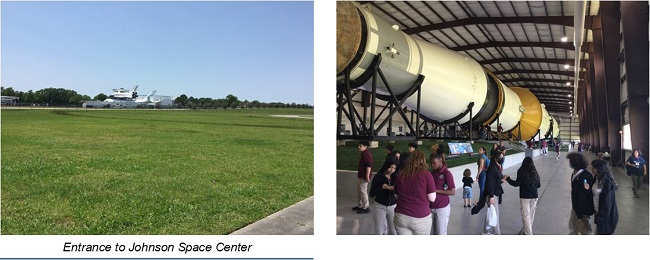
I stayed at a hotel near the entrance to the NASA facility and Anthony picked me up from there to conduct the tour. Tours are open to the public and several are going on every day. Our first stop was the building that displays the Saturn V rocket. The Saturn V is truly a very large rocket with multi stages that was used to lift the first explorers to the Moon. It did the job, but was very expensive and a use-once-only vehicle.
Our second building of interest was the International Space Station Mockup building. They have an exact model of the ISS including each of the other country units that are now part of the ISS. This is where all of the astronauts that will work on the ISS train in advance of being deployed to orbit the Earth. Training for a mission can take up to two years.

Our next building was the Mission Control Building. There is a gallery where you can see the control room monitoring the ISS. At the time we were there, the Russian astronauts were getting ready for a “spacewalk” to service something on the outside of the module. There are cameras mounted all over the Station and you could see what was going on in actual time.
In another room there is a mockup of the control center that was in use when the first manned lunar mission took place. And a complete rebroadcast of the event was presented to the spectators in the gallery. That was most interesting to me, since I remember seeing that lunar landing and first footprint on the Moon on TV in my game room in my home in Pittsburgh July 20, 1969.
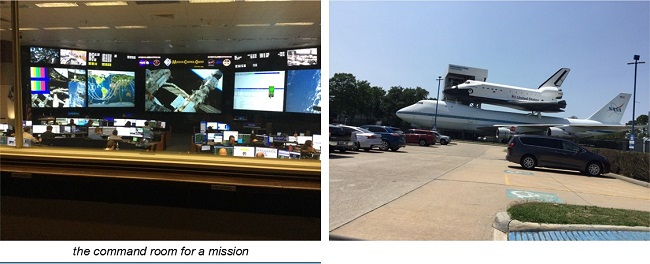
At the entrance to the Johnson Space Center there is a Boeing 747 on display with a Space Shuttle unit mounted on top of it. The Space Shuttle did not always land back at Kennedy Space Port in Cape Canaveral, Florida. If it landed elsewhere it had to be transported back to Florida for another launch on the specially modified 747.
A tour of the NASA Johnson Space Center can take several hours. Anthony knows his way around the facility very well and is certainly no longer that 15-year-old young man that flew from Pittsburgh to Tucson with me. He answered all of my questions and had a great knowledge of the history of the Space Program. I will look forward to another tour in the future!
