

By Howard Deevers
We all learn the “Alphabet Soup” of airspace when we are becoming pilots: Class A (18000 to 60000), Class B (Big, Blue, Busy), Class C (not so busy or big, but has rules), Class E (has rules, but not so restrictive), and Class G (uncontrolled and easy).
Did I forget the Class D Airspace? Easily found on your sectional, they are inside a circle of dashed blue lines and have a control tower that may operate around the clock, or only certain hours. When is Class D NOT Class D? When the control tower is closed, the airspace reverts to Class E or sometimes Class G. Consult the Chart Supplement/Airport Facilities Directory to determine operating times and procedures.

Class B airports, like Phoenix and Los Angeles, are the biggest and busiest with multiple runways, full-time towers, published approaches and departures, and radar coverage. Class C airports, such as Tucson, offer the same services on a somewhat smaller scale. In contrast, Class D airports are busy enough to have a control tower and instrument approaches, yet quiet enough not to need radar separation. Class D airports are often found under overlying Class B or C airspace. Looking at the Phoenix TAC and sectional charts, we see seven Class D airports underlying the Phoenix Class Bravo – Falcon Field, Chandler Muni, Mesa Gateway, Goodyear, Deer Valley, Glendale, and Scottsdale. Note that Luke AFB is also marked as a Class D, while Davis-Monthan is included in the Class C airspace with Tucson International.
Class D’s are typically shaped like a cylinder from the surface to 2500’, with a radius ranging from 3 to 7 miles, with 5 miles being most common. When tucked in under overlying airspace, the Delta usually goes up to the floor of that airspace. (Note the – minus sign on the sectional.) A student pilot certificate and two-way radio communication are the basic requirements for entering a Class D, along with weather minimums of 3sm visibility, and cloud clearance of 500’ below, 1,000’ above and 2,000’ horizontal, abbreviated as 3512.
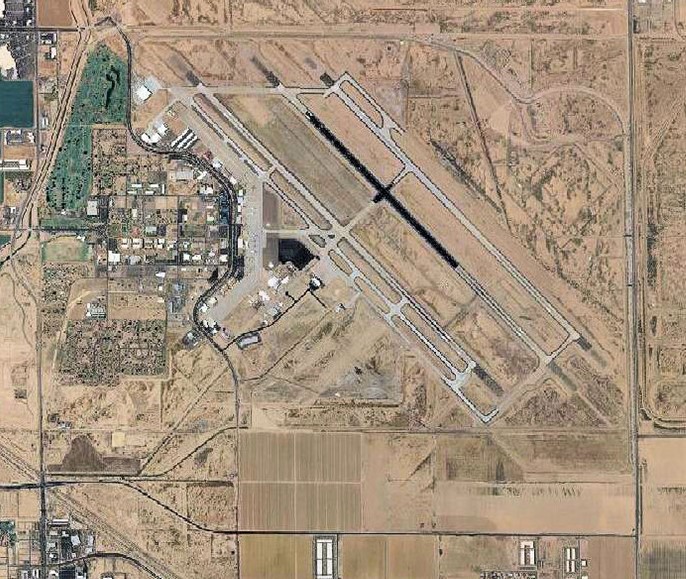
The controller gives permission to enter their Class D airspace, separates arriving and departing aircraft, and issues takeoff and landing clearances. They also direct ground traffic and provide weather information. Like controllers at larger facilities, knowing the different speed and performance profiles for numerous aircraft is an integral part of separating and sequencing arrivals and departures.
How can pilots help controllers in Class D airspace? Be prepared! Know the Class D airport location and boundaries. Are you ready to listen and talk? Listen first to ensure someone isn’t already talking on the frequency. Then call with the tower name and your N number to start the conversation. Once communication is established, use this simple, three-step formula for talking: Who you are (aircraft type and number), Where you are (accurate direction and distance from the airport. Saying “10 miles out” isn’t specific enough), and What you want to do (inbound for landing with information Alpha).
It may take a few moments for a reply if the tower controller is busy, so be alert and listen for your instructions. Copy the instructions on your kneeboard and read them back to verify you got accurate details and understand what to do. You and the controller will then correct any errors. This seems to be the hardest part for new students. It takes time and practice to listen, copy and readback, but it will get easier the more you do it.

After landing, exit the assigned runway as soon as practical. If you can make that second turn off, congratulations, but if you land long and need to use the very last exit from the runway, that is okay, too. Just move at a reasonable speed and remember the “hold short line” is dashed on the runway side, meaning all parts of your airplane must be across those lines to be officially clear of the runway, which then allows other aircraft to use it.
Once you are fully clear, you will be handed off to the ground controller for taxiing instructions. Use the same formula of “Who you are, Where you are and What you want to do.” If you aren’t at a familiar airport, have the airport layout/taxi diagram available, so you can see where you want to go and how to get there. If you are uncertain, ask for progressive taxi instructions. This is especially helpful when an airport is under construction or doing runway repairs.
Class D airspace is an excellent way to begin learning how to work with towered airports and ATC personnel, increasing your comfort level, capabilities and safety habits in busy airspace.
For more information on airspace and many other safety issues, come to a Safety Seminar sponsored by your ARIZONA PILOTS ASSOCIATION and the FAASTeam. Check the website for a location near you, and don't forget to “Bring your wingman!”